Thursday, October 8, 2015

Is he Autistic enough?

First, allow me to say hello! I know I have been gone for a while, but any of you who have busy lives will understand that some times we have to take a break and focus on the world we live in.

As you can tell by the title of this post, this is going to be a sort of therapeutic vent session for me, as I am pretty angry with some of the treatment we have received. Aiden and I have been pretty involved in the Autistic community since his diagnosis in May 2013, until this year. I was set to get involved in instruction and taking a more active role in community involvement when that seemed to just fall off the face of my proverbial map. The individual who was set to get me involved with all that ceased communication with me on the topic entirely.

I went out to lunch, after a fundraising event, with one of the co-founders of the class I was set to start teaching. During the course of this lunch this individual, who I thought was a friend, asked me if I had gotten a second opinion on Aiden's diagnosis, because it did not seem that he was truly Autistic.

As you can imagine I was floored by the comment, especially from someone who has a child with low functioning Autism. I have ceased involvement in the organization completely and recently allowed my membership to lapse.

There seems to be a type of discrimination within the Autistic community. My son seems to not be "Autistic enough" to be involved in the Autism community. As you all know my son has high functioning Autism. We've had him involved with ABA and OT over these last two years and I'd swear by them both. The coping skills they have taught him have been priceless and I continue to watch his behavior and mannerisms improve greatly. The earlier the intervention occurs the better off they are in the long run. Aiden still stims. He still has sensory processing struggles. He still has Autistic tendencies. Aiden still has and will always have Autism Spectrum Disorder.

I am grateful in a selfish way, and I'm not afraid to admit it. I'm grateful everyday his Autism is high functioning. In a way I hoped other people would be happy for us, knowing their struggles. I'd like to make an emotional comparison, not a literal one at this point. To me it would be like being angry someone else is cancer free when you yourself have cancer. I feel for those with low-moderate functioning loved ones. I don't pitty them, I feel their pain. Their daily struggles I can only imagine and I see the frustration. I see the monetary costs. I know it's overwhelming, but I do not presume to know it all about their daily lives. People see my son and say "Well I don't see how he could be Autistic. He doesn't act like it at all" and I just want to scream: "Do you know how much work that takes?!" Do you know how on the ball I have to be as a mom to scratch that surface? Do you know how many fights my husband and I have had over money and therapy needs? Could you even begin to understand how perceptive I have to be to him at all times to maintain that sweet little boy you see before you? How much I have to assess his surroundings to keep you comfortable?

I suppose I am further angered because my son will be the one to advocate for others, from a literal first hand perspective. He is the future of the Autism community and just because he is verbal, capable, and able to express himself, does not mean he does not have his own struggles with this disorder. How could I expect anyone to understand that? You cannot see the characteristics right away when you see him, so how could he possibly have Autism? You cannot see my psoriatic arthritis, so how could I suffer from the disease?

It is positively maddening when a community of people who scream and fight for education and acceptance, ostracize one of their own. It is absolutely counter productive for a person to assume they have "seen" Autism, when this community preaches that no two Autistic individuals are the same. This community demands the public to accept Autism and then refuse to accept my son, who is High Functioning, but not "challenged" enough to be classified as "Autistic enough" for them. At least that is the message I am receiving based on their actions and words.

The emotional toll of a diagnosis is high. Anyone who has ever sat through a diagnostic meeting will understand what I mean. When someone questions that journey all those feelings come back. You remember everything about it and how you felt. It makes you angry and it hurts, especially coming from people you should feel "safe" talking to about this situation. People who come from an area of like experiences.

I suppose I just expected more. I'm just grateful he is still to young to have formed attachments to people in that organization. I wish them the best on their unique Autism journeys, but my family will no longer join them on their path. It's sad, but necessary for our overall well being.

I hope that this helps someone else out there not feel so alone. High Functioning Autism is still Autism. All we want is acceptance, just like anyone else.

Thank you all for understanding. Please feel free to follow us on Facebook: https://www.facebook.com/AidensHereos

Friday, February 20, 2015

Alan Turning

If any of you have been following the movies lately, you have no doubt heard of or seen the Imitation Game. This movie, based on the true story of Alan Turning, is a beautiful story about a misfit genius, turned war hero, who cracked the enigma machine during World War II. This movie has also done something else, it has created a renewed dialogue about Autism.

 While watching the movie my husband turned to me in the first 5 minutes and asked "Is he Autistic?" Of course I didn't know, but he read my mind. Actor Benedict Cumberbatch and co stars have said that he did not purposefully portray Autism characteristics while acting as Alan Turning. "That conversation never came up on set" Keira Knightley said during one interview. Purposeful or not he hit the mannerisms right on the head, the poor social interaction, intense interests, the literal acceptance of every thing, and little to no friends all indicate high functioning Autism.

I was curious so I looked up whether Alan Turning was diagnosed with Autism, he had not been before his death in 1954. Retrospectively experts think Turning may have been Autistic, but they cannot be sure.  There are conflicting reports about his personality and mannerisms from family and small group of friends. There is no doubt Turning was an absolute genius that touched multiple areas of science. Turning is credited with creating the first computer, the Turning Machine, along with many more accomplishments. There is one other explanation for Turning's aloofness. Turning was a homosexual. During the time of his life homosexuality was illegal in the UK and punishable by up to life in prison. It could be that Turning was "odd" because he was trying to hide that part of himself from the public, he did get married in an effort to further hide this secret.

One thing is for sure: I want to thank Benedict for his beautiful acting job in the Imitation Game. We, as an Autism community, should be grateful for any dialogue that is opened, accidental or purposeful, regarding our loved ones diagnosis. It gives us a perfect example to point to about the mannerisms and habits commonly seen in HF individuals. Movies are here to entertain, so not every fact they give is 100% correct, but it can be used as a visual example. We now have the responsibility to work off this foundation and correct misconceptions by the public from the Hollywood spin.

Do I think Alan Turning was Autistic? I think there is a good possibility that Alan Turning was, but without knowing him personally I don't think anyone can say either way. Regardless, Alan Turning is a great role model for our kids and the perfect example for acceptance of all different kinds of people.


If you would like to read more about Alan Turning, please feel free to read his biography or view this article on Wikipedia. 

Sunday, February 1, 2015

Parental Fitness and Autism

I wanted to take the time today to talk to everyone about parental fitness. This is not, on its face, related to Autism, but it does impact the quality of life you experience and your loved one experiences. I know to sometimes the world of exercise seems like a secret society. I want to help you navigate it with this introduction. We all have heard the multiple benefits of exercise, so instead of harping on it I wanted to share how I have been maintaining an exercise routine in my hectic house.

Aiden was born in 2011 and my daughter was born in 2012, after she was born I weighed 180lbs. On my 5'6" frame I was able to hide it, but that didn't mean I was happy. I had been struggling with my routine already, since sustaining a knee injury in a serious car accident in 2009, which required two separate operations in 2010 and 2011. Aiden was diagnosed with Autism in 2013. At that point I had two children 2 and younger and one had a life changing diagnosis. Also in 2013 I was diagnosed with arthritis, which further contributed to my fatigue and stress. My story is not special. My story can be shared by many people throughout the country, maybe even by one of my readers. So why share it? Because I want you to know I understand where you are coming from. Raising children is a struggle on its own, add in health stressors, work, and general family life, its a wonder that anyone can maintain their sanity. So how do I do it?

First thing I'll say is I started buckling down again on my fitness routine in mid-2014. Aiden was a very mature 3 year old and Haley was almost 2, so they could and did entertain themselves for a decent period of time. It is hard to maintain a routine with a baby around or a young toddler. I tell new moms to just go for a walk. put the baby in their stroller or strap them into their baby carrier and take them for a walk. Its a great bonding tool for you and your little one, it helps expand their vocabulary if you talk to them during the walk, and you are beginning to lay the foundation for your future workout regimen. Don't think after having a baby you are just going to jump right back into your workout routine. Don't over exhaust yourself, take the time to just be a new mommy. It is an all consuming adventure. When you have recovered and have regained a "normal" sleep schedule again, then start really hitting the workouts again. If you have a gym membership take the little ones to the kid care area and go work out. It gives you a break,which is fantastic, and you get your workout in.

When you decide it's time to either being a workout routine for the first time in your life or to start back up you have to understand that this is for you and no one else. You cannot make a life changing decision for anyone else but yourself. This is your selfish time, it is your selfish act. You also have to realize the investment. You will be dedicating a portion of your week, probably around an hour in length at least 5-6 days a week. You will be investing money into fitness. You don't have to invest a whole lot, but you will be paying for equipment and items to help you with injury recovery. Injuries can and do happen with exercise.

So lets talk about how to set yourself up for a fitness routine. First and foremost you need a good pair of shoes. Yes, shoes make all the difference in the world in the health of your joints and feet. I am by no means saying you need to go buy $100-$150 or more for a pair of shoes, which you very easily could. If you do, then that's fine, I cannot afford that. I look for a good pair of Nike's, Newbalance, or my personal favorite Asics. I specifically search for running shoes, but you can also select a pair of cross trainers. Yes, there are specific shoes for specific activities. If you are interested in a cardio routine then running shoes will do well for you, but if you want to lift weights, play sports, or engage in a very dynamic routine then go with cross trainers. Cross trainers are designed to offer support to your ankles during side to side movements, or quick turns, but are lighter than regular tennis shoes and offer more cushioning for running. Running shoes are lighter than regular tennis shoes and cross trainers. They are designed for forward motion only. If you have never ritually exercised before I strongly recommend getting a pair of cross trainers. I say that because it will help you prevent more injuries while you are learning how to exercise.

Buy yourself a few different types of workout DVDs, like Pilates, yoga, cardio based videos, etc. You really only need two or three to start off with, that will help you diversify your workouts. Also pick up light hand weights. Start with 2lbs, 5lbs, and 8lbs. Then you can move up as your weight lifting routine gets easier. Also pick up some light ankle weights or ankle weights that allow you to add weight to them as you get stronger. You will also need a yoga mat. A yoga mat is something I always underestimated until I bought one. Now, its almost a requirement. The mats help so much to cushion your back and hands while doing push ups, sit ups, and other floor workouts.

So you got your equipment, you have some athletic attire, what else do you need? You need a well stocked medicine cabinet. Start with ice packs. I love, love my Mueller ice pack. It never fails and it has a velcro strap that helps hold it in place wherever I put it. Get yourself 2 ice packs minimum and just keep them in your freezer. Ice is your first injury treatment. If you turn an ankle or fall and hit your knee wrist, etc, the first thing you put on is ice. Ice for 48 hours then heat for 24. That being said the next thing you need is a heating pad. You only need one. Ibuprofen is probably something you already have, it helps with inflammation and soreness. You also need to make your your first aide kit is up to speed, band-aids, ointment, ace bandage wraps, etc. Some optional items are icy hot and the smart relief TENS machine. These items are inexpensive and you can use them to help your sore muscles and treat injuries.

One of the biggest struggles you will find is with diet. You will be hungry, but that feeling goes away. If you have conditioned your body to eat 3,000 calories a day, when a typical woman only needs 1,500 calories a day, you will experience hunger. Drink water during that hunger. Keep your calories down and try your hardest not to break the threshold. You will do that on occasion, don't be to hard on yourself over it. Wait an hour and do a workout. You will have intense cravings, they will subside. Allow a cheat day one day a week during which you eat whatever you want, then the next day you buckle back down. Over time, cut cheat day down to a cheat meal. You will find that I had to cut almost all carbohydrates from my diet before I saw a dent in my weight. I had to only allow myself to eat wrap sandwiches 2-3 times a week. Everything else was carb free. You may find that will not work for you. Maybe sugar is your nemesis. Chocolate is mine.

I allow myself to buy one bag of snack size chocolates and I started out eating two a day, then cut it to one, now I only eat it when I crave it. Your diet control starts with the grocery store. Shop along the outside perimeter of the store.  That is where the fresh foods are kept. A big part of maintaining a healthy lifestyle is learning to cook with fresh foods. In the frozen foods section try the different health foods Smart Ones, Weight Watchers, and Healthy Choice are some of the options I have tried. The foods are getting better and better in quality and taste, though they should not make up the majority of your diet since they have high sodium content. These meals are fantastic in a pinch or an unexpected late night. The key to diet is variety. Try different fruits and vegetables, you may surprise yourself and expand your tastes. Its easier now more than ever to get healthy recipes online and through social media. The last thing I will recommend in this section is water. I recently picked up a water bottle that holds 2.2 L, which is equal to 8 glasses of water. I drink one of those full water bottle a day, minimum, but usually I drink more. I only allow myself one caffeinated beverage a day, but that is because I cannot drink coffee. I drink energy drinks (bad I know), but I am human and I have my vices.

Now you have your clothes, an up to date medicine cabinet, and a healthy refrigerator, lets start the exercise routine. Find what works for you. For some of you its Zumba, P90X, or good old fashion running and lifting. The point is to do what you can do and everyday you do something, unless you are injured. Find an eclectic mix of things, that way when you start to get lazy or tired, you can switch to a different type of exercise. A good amount of exercise videos can be found online or can be ordered in the mail. You can also sign up for a gym membership. If you have no previous workout experience I do recommend this. This will give you access to trainers, other people at different levels of fitness, fitness classes, and other resources. Don't be afraid to ask these people questions. If you have a pain or ache stop someone who is obviously on a break and ask them about it. Ask the trainers about it, they will tell you their opinion and it will teach you a great deal. If you have a question about the machines or a particular movement ask someone. Hiring a personal trainer is great, if you can afford it. A lot of people who work out understand where you are because they had to start somewhere too and most of them would love to answer a question or two. Try not to get in their way or take up to much of their time, since they are also there for a workout.

When we cut back on our expenses the gym was the first thing to go. Between my workout apps and videos, along with my prior knowledge I work out effectively at home. I simply give my kids their lunch and turn on a movie they love. I then go into our office, leave the door open and begin my routine. I eat after my workout has concluded. If my husband is home then workouts suddenly become so much easier, since I can go on my runs and leave the kids with him. My workouts are usually 45 minutes to an hour long and I have recently started working out twice a day when I am off work. As far as when I workout I prefer mid morning and late afternoon workouts, but that depends on you completely. You have to find a time that works well for you. It could be a 30 minute chunk of your lunch break on work days, maybe you prefer to wake up earlier or you can work out when you get home. Finding a time that works for you is just as important, if not more so than finding a routine that works for you and you have to stick with it.

Something that has recently helped me jump start my workouts again is my fitness tracker. I purchased a Jawbone Up, but there are so many others out there you can have your choice. This little piece of equipment keeps track of my sleep patterns, steps, workouts, my diet, etc. A tool like this has taught me how my calorie intake is directly impacted by my exercise routine. It also has helped me make better food choices. You don't have to have one to start, and if you follow the process you set for yourself you will probably find that the weight falls off at first, which is exactly what you want. This item helps when you hit a plateau or find yourself going backwards.

Plateauing in your workouts is not uncommon at all and it simply means you need to switch up your routine in exercise or diet. If you notice your weight increasing, critique what you have been eating first. If there has been no change in your diet, then you are probably gaining muscle, which is good because muscles eat fat. The more muscle mass you have the more fat you burn.

Over the last few months I have lost 22 lbs and gone down 2 jeans sizes. It's a liberating feeling and if you are considering starting an exercise routine I hope you found this helpful. I think as you stick with your routine you will find working out gets easier and easier and your body actually craves the exercise. You can do it on any budget and with kids at home too! 

Wednesday, January 14, 2015

Relationships...

I wanted to take a moment today to have a conversation with you. It's not really Autism related, but I wanted to point something out in the world of parenting and relationships. Yes, despite your loved one having Autism, some of you are parents or behaving as caregivers.

Have you ever noticed, when you devote your life to someone else, you lose your identity? Think about it. When someone asks you to describe yourself, what do you tell them? What is the first thing you say? I always say "Well I'm a mom". Stop. Did I answer the question? No, not really. Describe yourself, WHO are you, not what are you. I am a smart, disciplined, outgoing, funny and strong woman, but is it selfish for me to acknowledge those parts of myself, since I am not putting my kids first?

Society puts such pressure on parents and caregivers. Somehow you love your little ones less when you think of yourself and that is just not true. Couldn't be further from the truth, actually. Think about the first time you met other parents in your kid's class. How did you introduce yourself. "Hi, I'm Aiden's mom." As if you have no other identity on this Earth and your sole purpose is to function as your child's caregiver, twenty four hours a day, seven days a week. That is your primary purpose, but it is not your sole purpose. We cave to pressure. What you really have just said is "Hi, I love my kid so much and I don't want you to think I don't, so I'm going to put them first and then smile really hard through my coffee coma, because I am literally so exhausted, but I don't want you to know it because we are all Betty Crocker and Suzie Homemaker and We Can Do It poster material". What in the world is that? Why do I care? Because somehow we have come to value other's opinions first, then our families, then our friends, then our own. Why? How does your perception change when I say "Hi, my name is Sarah and Aiden is my son"?

I have just created my own identity and established that I am my own individual, separate and apart from my child, while maintaining that my son is important to me. Does it come off strong, it might. I have always had a strong personality, so I've had to accept that some people are uncomfortable with that. I have also told you that I am human, separate and apart from my child, and I'd like you to acknowledge that part of me. Ask other parent's for their own names and ask what they do for a living. Help them to think about themselves, you will find that people value being thought of as individuals.

Think about your friends. Do you have "selfish time" friends? Aka, friend that are not at all connected to your child other than through you. The people you spend the most time with are probably those you have met through your child and your friends are the parents of your child's friends. They are good people to have around, but I think you will find that some of them eb and flow. They leave and may come back, depending on the children's relationships. That's ok. It is a natural part of relationships. You are gaining from the relationship, as are they, until one of you is no longer gaining and then the friendship will fade. It's nothing to be sad about, but it is something to expect. Selfish time friends are important, because they care about YOU. They like to go out and have fun with you. So go out to lunch or dinner and have fun. You'll find that they can get your mind onto topics other than your child. Most parents brains are totally consumed with their children. I always find myself talking about my kids to other people. Why is that? Because your kids are literally on your mind ALL the time. And why shouldn't they be? They are people you are responsible for. That's a big undertaking. Sometimes I wonder what I ever talked about before I had kids, until I go out with my "selfish time" friends.

In some ways I find them rejuvenating. Some of them have kids themselves, so they can identify with kid issues, but we have never met their kids and we only keep up with their kids through social media. It is nice to have friends like that. They remind you of who you were before you became a parent or caregiver. You'll see them less after your child is born, and they will understand, but don't lose them.

I know its hard for some of you to find caregivers while you are away. There are a lot programs that are popping up that will allow you a few hours to yourself, ask your care team if they know of any. You need to take a break for yourself. Don't be afraid to maintain an identity as a human being, separate from your child. Don't be afraid to maintain that same thing with your spouse.

It's no secret that Autism puts strain on a marriage or relationship. It drains you both physically, emotionally, and financially. It drives a wedge, don't be afraid to flirt. "Hey there handsome" will make him feel good. "Good morning beautiful" will make her smile, especially in sweatpants and ripped up old shirt. You have to build each other up and what does it really take, but a moment? Contact is so important to human beings. A hug, a simple hug, can lower your heart rate and release endorphins. A gentle touch can break a stress cycle. Hold hands. Something as simple as that can do so much when you're just walking together or arguing about something. It actually forces you to listen to the other person, because it physically reminds you that there is another person there with you.

Adult relations probably take the biggest hit during child rearing for typical parents, so imagine what it does to parents in your situation. I know you are already tired and I know you feel like literally falling over at the end of the day, but make time. Realistically what does it take? 15 more minutes of your time, if your lucky. (That's a joke, ya'll, laugh.) Don't let the love you had for each other before kids, be the only thing expected to make a relationship last. You have to maintain it, just as you need to maintain yourself.

Finding a balance is hard and nothing will ever be 100% balanced all the time. Most of the time life feels like a rat race, therapists, doctors, school, work, it can be overwhelming. I recently had to break that cycle. I was stressed, forgetting appointments, and found myself unwilling to go to the ones I did remember. I have stopped taking Aiden to some of his specialists. We have gotten the answers we need for now and its time to just de-clutter the schedule. Some of you don't have that luxury and I understand that. Try to pick two days in the week, minimum, where you do nothing, it can be a school day since you are not the one in class. You sit at home and watch movies or read books, one of those days, once a month, try to get together with a friend or two. You'll find it helps your peace of mind. Meet your spouse for lunch, if you can, during the week and enjoy a moment together. You'll find it does so much for your state of mind.

Good luck and we hope you have enjoyed this moment. Thank you for sharing it with us!

Wednesday, December 31, 2014

No clothes...Again?

Have any of you ever encountered this? Aiden is going to be 4 soon and he still strips down the the nude. I have heard other parents talking about their children with Autism doing this. Why is that?

Don't let this worry you to much. What I've found is there are a lot of people who do this, particularly when going to the restroom, and it is certainly a behavior not selective to Autism. A good amount of parents say their children out grew the behavior. I hope that offers you some comfort.

I have found that inside our home Aiden strips completely, its what he feels comfortable with. In public he stays completely dressed. Our daughter just turned 2 and hardly understands what nudity is or what the differences are between boys and girls. We have been trying to get Aiden to leave his clothes on in the house, but find being clothed all day seems to overwhelm him. Aiden is day time potty trained, but at night he still sleeps in a diaper, refusing to sleep in bed clothes.

A high functioning child, like my son, can understand the need to wear clothing in public. Sometimes with nothing more than a simple explanation. Understanding the perceptions of others and the appropriateness of social situations in regard to clothes maybe lost on them at first, but seeing you wear your clothes in public will help. Be contentious of how you explain this situation. Children can be impressionable and you really want to avoid making them feel uncomfortable with their bodies. Something like "Mommy wears clothes. Daddy wears clothes. Sister/brother wears clothes. Grandma and grandpa wear clothes. So you wear clothes too."  This rational "normalizes" the behavior.

So what do you do if your child is not high functioning? Continue to explain to the child what it is you expect, just as you would for any other child. There are some things you can do like turning the clothes around so the buttons, zippers, fasteners, etc are in the back instead of the easily excess able front. You can also try dressing in layers.

The explanation I found most acceptable was the sensory one. As you know certain textures of clothing may be found to be irritable to children with Sensory Processing Disorder or Autism. Things like tags and rough fabric may be one cause for stripping. Fabric softener is a good way to soften clothes if rough texture is difficult on your loved one. It was explained that some children need the pressure that loose fitting clothing cannot provide. So the loose fitting clothing may be seen as an annoyance.

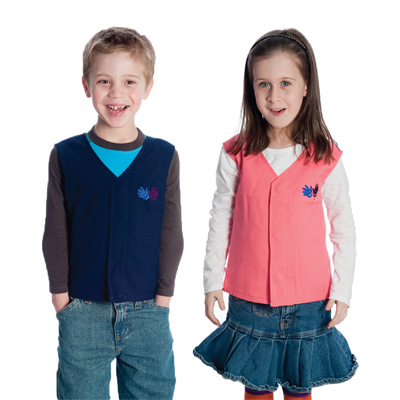
This got me thinking, what if you dressed your loved one in clothing that provided more pressure? How in the world do you do that without tight fitting clothes? Swimming shirts like those that swimmers and surfers wear are made of spandex type of material and may provide the right amount of pressure. They are tight enough to fit under clothing and maybe acceptable to your loved one. Its worth a try if stripping is a constant issue for your family. Another solution comes in the form of weighted vests and shirts. They are sold online from multiple different companies and are fairly common in the Autism community. They range from $50.00-$100.00 each. The vests function much the same as weighted blankets and are being designed to be more fashionable.


Lots of products are being fashioned to help your child or loved one with their sensory needs. I stumbled on seamless socks today while looking at different types of vests. Therawear has some for sale on their website, but I cannot determine of the price is per pair or per set. I have also found that Striderite makes some as well. Either way for some parents and caregivers things like this maybe priceless. 


Here is a blog from a sensory mom that gives great tips for dressing a sensory sensitive loved one. I hope this helps you: 11 More Tips for Dressing Your Sensory-Sensitive Child

Here is a link to other sensory coping items for use and wear: Must Have School Gear for Kids with Sensory Issues

For more tips and help with your specific struggles contact speak with your care team. Behavior modification provided by your ABA will be specifically helpful during this struggle. An Occupational Therapist can help with any sensory issues you maybe experiencing.

As always we are here for you at Aiden's Heroes. Follow our Facebook page and Pinterest boards for the latest and greatest from us. Thank you for including us on your Autism journey. 

Friday, December 12, 2014

Tis the Season


"Tis the season to be jolly" they say. Beautiful lights, the smell of pine and cinnamon, happy screeching children, the wrapping paper, bows, carols, family, friends, meltdowns, jingling bells...wait, meltdowns? That's right, meltdowns. Your loved one with Autism will be subjected to more sensory input now than most times of the year. Holidays are always a challenge, even for high functioning kids like Aiden.

Aiden has been particularly sensory sensitive for about a week and a half now. We've had a cold front move in, so all his clothes are long sleeves and pants. People in the neighborhood are putting up Christmas lights. Almost every store you walk into is blasting Holiday music and the smell of pine and cinnamon are almost obnoxious to me, so to him I can only imagine. Out of town family is on their way if they aren't here already. Everything is just so busy and don't think for one moment the stress of the season isn't impacting them too.

How can you help them? Its more simple than you think. First, your out of town family. They, especially to little ones, are practically strangers. Some people believe that being family there is an implied consent to touch, hug, or kiss, your little ones. For typical kids this is acceptable and they can withstand it for brief moments, not so for kids with Autism. Its not that they're being mean, but if touch is few and far between for people in their every day lives, then it is certainly unacceptable for people they hardly know to touch them. So what do you do? Send your out of town family a list. Tell them what the likes and dislikes are for your child and allow them to exercise the "likes" within reason. Most people don't know what to do around a child with Autism, so they over compensate, almost to a sickening level. Your loved one's mannerisms may be unsettling if the behavior isn't understood. If you notice your loved one connecting with a particular family member, take them aside and talk to them. "I see that (insert name here) has really taken to you. That bond is really something special, its hard for (insert name) to connect with people, but you've made it easy for him/her to connect with you. Thank you for being so great with him/her."

How do you handle stores? First know what your child is sensory sensitive to. Aiden isn't particularly sensitive to smell, he will point it out unmercifully, but he can push past it for a time. If you notice a store with strong smells, try to go alone. I know that's tough. Can you order your items online? Sometimes shipping fees are worth it to avoid sensory meltdowns. If not and you must take them call the store the day before. Explain your situation and ask if they will pull the items for you, so you can just go right to check out. I'd be willing to bet 99% of stores will accommodate your request and if your store falls into that 1% that won't, then their competitor will.

Sound is Aiden's Achilles heel, as most of you know by now. We solve that problem with ear protection. Its relatively inexpensive and you can pick up a pair at most surplus, big box, or hunting supply stores. Just keep a pair in the car or in your purse and a pair in the house. That way they can enjoy the same things you are, not be tortured by them.

The holidays can be fun for everyone with some help from you. You're an important part to your child's successful holiday season.

We here at Aiden's Heroes want to wish you and your family a very safe and Happy Holiday and New Year. We hope this next year is better than this one and that you continue to join us on your Autism journey.

You can always connect with us on Facebook and Pinterest! 

Friday, December 5, 2014

To Tell or Not to Tell

Its one of the hardest decisions. Do I tell my child they have Autism? If their low functioning will they even understand? If they're high functioning and doing well, does it matter? Will telling them make them conform to a label?

As the parent of a child with Autism I understand these frustrations and one day I may be faced with the situation. I think this decision is personal to each person. I know, being the type of person I am, I would rather know than not. To me its like the doctor withholding that you have cancer. Now we all know that Autism is nothing like cancer. Cancer can eventually kill a person, but Autism alone does not.

First I think its important to know your child is aware there is something "wrong" with them from a very young age. My son asks me why he has to see so many doctors and he is almost 4. My husband and I don't speak about Aiden's Autism on a daily basis by any means, we just know its part of who he is and we just accept it as part of our normal daily life. If I have to take Aiden to a specialist I say "Aiden has a doctor appointment", but I usually don't have to elaborate. We don't refer to our therapy team as their specialization, like our ABA or OT, we refer to them by name. Still he knows. How? His sister. Our daughter, from what we can tell, is neurotypical. She goes to the appointments with us, but is not there to see the doctor.

For right now, when Aiden asks me what is wrong with him, I simply respond: "Nothing, you are just so awesome and everyone wants to know why." That's good enough for now. I know, when he goes to school, one day he is going to ask me "Mom, do you ever feel different for other people" or "Mom, I don't think I fit in" or "Mom, why is it so hard for me to make friends?". That is when I'll know that it is time to start talking about it.

How you tell your child is going to be important. How you tell them can set the tone for how they react to their own diagnosis. Have you ever received a life changing diagnosis? The day I was told I have psoriatic arthritis and would need medication for the rest of my life was a life changing day for me. The day we received Aiden's diagnosis was a life changing day for me. Those are days you don't ever forget. That will be this day for your child. You need to know your child's temperament, personality, and character. Talk to your child's psychologist or trusted member of your care team around your child's 5 or 6th birthday. High functioning children become self aware of their differences around the age of 6 or 7.

So what about the children who are lower functioning? Remember, low functioning does not necessarily mean unintelligent or low IQ. I've discussed this in prior posts. Its fair to assume they know there is something different about them at or around the same time as their higher functioning or neurotypical peers. If you chose to tell them I would do so around this same age.

How do you introduce it? Slowly. My son is involved with the Autism Society of Greater Orlando, so I can only assume, at some point, he will put two and two together, if you know what I mean. He will draw the connection on his own. I envision the conversation starting with one of the questions I mention above. Of course I feel different than my peers. I've always felt that way, even from a young age. So I would start out by saying "I understand how you feel, but sometimes there are reasons for our behavior that other people can't understand without help." Like what? See I have this question easy. I'm a cop for a living, most of you know that from my prior posts. We act differently than other "normal" people because of what our job expose us to and how we are trained. I mean do you really care if your back is to a door at a restaurant? Probably not a deal breaker. For us, big issue. Those kinds of things. So I'd probably point out some of the weird things I do in public because of my law enforcement background. Then it would probably transition to "I know I am different because I was trained to be. You may feel different, but that is because you were born with a different way of thinking than other people. The way you think is known to others as Autism." That begins the questions.

You know the level you need to speak to your child on. Their "maturity" level as its called. Try to explain it in a way that is easily repeatable to their friends, if they are verbal, but make it clear they don't have to tell anyone if they don't want to. Welcome their questions with an open heart and open mind. If you don't know the answer don't make something up. Ask them what they think and if they don't know, then take it upon yourself to find out for them. Tell them you'll look it up or ask. Don't be afraid to show your humanity to your child when you are reminding them how human they are. You are not superior, you are experienced, there is a difference in the delivery and that is true for all situations, not just parenting.


Older children may have an idea of what Autism is. They may already have associated it with being something negative. You will have an interesting set of challenges as a parent in this situation. I still believe they should be told, but don't be surprised if they don't want to talk about it right away. Respect that space. Tell them you want to talk about it and answer their questions. Enforce that this is not who they are, its just part of who they are. Remind them no one is perfect, and this is a hurdle that they will overcome in their life. But above all remind them they are not alone in this. You are there for them. Let them come to you when they are ready. They may do some research on their own at first. Never demean them from doing that, instead applaud them for their maturity and for educating themselves. Engage them in the topic they present, be honest and sincere, but not judgmental. Unless you have Autism, you are limited in knowing the full extent of Autism. I can research Autism, write this blog, live as a mother to a child with Autism, cry with him, hurt with him, and fight with him, but I can not be him. I cannot live his life. As much as I may wish to jump into his head for one day, I can't.

Remember to think about how you're going to deliver this information to them. How you tell your child about their diagnosis will set the tone for how they feel about themselves. The diagnosis is not a definition of who they are. When people ask your child to describe themselves, what would you want them to say? Autistic is not what I want my son to say first, if at all. Autism is just one part of who he is. For other parents, especially with those who have low to moderate functioning loved ones, they may want their child to introduce themselves and immediately volunteer the fact that they have Autism. This is a safety concern I understand and advocate for based on the individual.

This is just my opinion on this topic. Some others may feel differently than I and that's ok. As always, we here at Aiden's Heroes are here for you.


Saturday, November 15, 2014

My Husband, My Hero

It's occurred to me I've never said thank you. I've never told you how much I appreciate you. I've never said it and I need to. I should have before now. When things got tough, you stayed with me. You've held my hand when I've cried. You listen when I'm angry. You make me smile when I don't want to. I don't know if you do this because you know how or just because you can. Yet, through all my meltdowns you love me. You love me when I'm flawed, you love me when I'm weak, you love me when I'm scared, and you love me when I just need a day in sweatpants. Thank you.

Thank you for making me feel like I'm more than any other woman. Thank you for letting me shine. Thank you for being my dose of reality in life. Thank you for music-less dancing. Thank you for goofy song lyrics. Thank you for long talks in the car. Thank you for kisses before leaving for work. Thank you for surprise love letters. Thank you for doing the dishes the other day. Thank you for the microwave meals and frozen pizza dinners. Thank you for being the saver, not the spender. Thank you for never yelling at me when we disagree. Thank you.

Thank you for fighting when I can't. Thank you for laughing when I won't. Thank you for finding the words when I can't think. Thank you for your prayers. Thank you for thinking of me. Thank you for picking up where I leave off. Thank you for letting me explode. Thank you for putting me back together. Thank you for enduring the fire of my personality. Thank you for kindness. Thank you for understanding. Thank you for support. Thank you.

Autism is genetic in my family, yet during our financial struggles, therapy arguments, and misunderstandings you've never blamed me. You've never accused me of being the cause. I've never said thank you, because in my few weakest moments, I do. I do blame myself and somehow you don't care. Somehow you love me despite my flaws. Somehow you love us unconditionally. Thank you for love I've never known. Thank you.

You're my husband, my hero, and I love you.


Monday, October 27, 2014

How the System Failed my Family

I'm going to take a moment to talk to you personally. I don't do this much, most of our articles are very educational in nature, but I need a break from research. I just want to be human right along with you if that's ok.

Over the last few months I've been coping with the reality that no one out there wants to help us. What do I mean by that? Well it all started with the public school system. Aiden was involved with a government program here called Early Steps. Part of the services Early Steps offers is called transition. In transition they set up a IEP meeting with your local school system to determine if your child qualifies for services through the public school system. The school system representatives informed us that Aiden does not qualify for an IEP based on his intelligence. They, in all their wisdom, made the determination that there is not an "educational" need for Aiden to receive these services. Now, the school system will gladly accept the medical diagnosis to get the addition money the receive from the government, but they will not give my child the protective contract he needs to ensure a successful educational career. You didn't know that the schools are paid for "special needs" kids? Yep, they surely are. The McKay Scholarship, here in Florida, takes that money away when the school fails your child. The school did say he should have a 504 plan. Which is a step down from the IEP and its not binding. I informed them of his sensory struggles, but that didn't seem to matter.

We then went and filed our tax return. I found out that amount of money we had paid out of pocket for doctors and therapy expenses did not meet the threshold necessary, according to tax code, for a credit. I was floored. We had been paying so much money, but it wasn't enough.

After that we attempted to secure secondary insurance for Aiden through Florida Kid Care. We have primary health care through our employer, but you have the ability to secure secondary insurance through another agency. One of the things Kid Care advertised that they offer is secondary insurance through Medicaid. However after Aiden was denied coverage through Kid Care (because he has insurance) we were told Kid Care does not actually forward applications to Medicaid. So my brainiac question was why does it say you represent them on your website? They informed me that their website does not advertise that information. A lie. You can go to their about section and see the information for yourself.

After our let down with Kid Care we reached out to the SSI department. We applied and went into the meeting. First of all allow me to explain a few things, to be fair. My husband and I are both employed. He is full time and I am part time. Now you'd say why aren't you full time? The answer is simple, we cannot afford daycare for our kids. Part time day care costs the equivalent of our mortgage payments, monthly. There is no possible way for us to swing that and it won't cover weekend work hours. That is why I am part time, but I easily put in about 30 hours a week at work, while I am there. So with that explanation in place, my husband and I were only coming out ahead about $200 a month, at best. Aiden's medical bills cost us about $500 a month with insurance. When we went for our SSI appointment they only wanted to know two things: 1- What is your gross income? and 2- Do you own anything? They didn't care about our household bills, because electricity is optional evidently. They told me that I could ask for help from Medicaid as a secondary insurance and that is when I broke down.

I have just started coming out of the withdrawal I have been feeling for months now. All the "fight" drained from me. Aiden missed appointments with specialists and I didn't care. Thankfully he is a very healthy little guy on his own. We have been trying to figure out what was causing his constipation, but we have that under control now, and that was the appointment he missed. I was spending money on doctors, therapists, and specialists hand over fist. Every week we had an appointment to keep and we needed help. Help we weren't getting and still aren't getting. My husband picked up two extra work shifts a week and that has off set our need.

This is why I lost it. I didn't feel like I was asking for much. I didn't feel like what I was asking for was out of line. I wasn't asking for my whole family, I was asking for Aiden alone. Just something to help off set the money we are paying for his care. In this country, you have to be drowning in order to get help. We were barely keeping our heads above water and were asking for help. You can only be smacked down so many times before you feel completely drained. Now I'm angry, but I don't know who to talk to about it.

In a sense we are lucky and I know that. Aiden is high functioning and if he weren't we would be worse off, but that is the mind blowing thing. I know people who have loved ones on the lower end of the spectrum and they have had to refinance their homes and take loans in order to pay for medical bills. What is it, exactly, that families in America have to do? I pay money to my government, involuntarily, for the benefit of others. I have met people who draw SSI benefits for things like epilepsy, yet they drive cars. For depression, yet they commit crime. So I fail to see how my request or better said requests are ungranted. And I feel that they escalated in the most proper manner I could think of, from "least" to "most" impactful.

Our story is repeated hundreds, maybe thousands of times, all over the country, by so many more families. Staying strong and present is hard after enduring so much. In times like this its hardest, but most important to remember you're not alone.

Thank you for letting me be human. Thank you for understanding, some if not all of what I am saying. Be sure to follow us on Facebook for the latest updates. 

Friday, October 17, 2014

Relax...Its ok

My son has Autism and my daughter is neurotypical. I have a husband and a job. I run this blog and the Aiden's Heroes Facebook page. I have a home sales business. Among all these things I have to find time to maintain my vegetable garden and stay on top of household chores. Many of you are a lot like me. Many of you have a lot of work on your plate. So you ask how do I find time to relax? The answer is difficult and simple: I make it.

I make time to relax. Sometimes it comes at the cost of house chores or a blog post, but finding time to maintain your sanity is very important. Did you know, according to preliminary findings from the IAN Network, as reported by Autism Speaks, approximately 44% of mothers and 30% of fathers to individuals with Autism have been diagnosed with clinical depression? The study reports that 50% of these cases began before the birth of their child with Autism. That means that the other 50% of the cases came afterword.

Stress is my biggest enemy. I find myself under constant stress and on an almost daily basis. Its tough on me and it makes me, at best, irritable. I know that and I notice when it gets worse. For instance today I am more edgy that usual. So I know its time for me to take time to relax. A 2009 article published by Disability Scoop discovered that, particularly mothers, of individuals with Autism experience stress similar to combat soldiers. What does that mean? Its constant. Its a constant bombardment of input and attempts to regain control of your environment.

Its easy for someone to say "you're the parent, so you are in control", but any parent of a child with behavioral disorders knows better. When you are the parent to a child with Autism you are barely holding your head above water, at least that's how it feels. You are probably more in control that you realize. I remember the first time our ABA therapist said "He listens to you very well". I could only say "Really? Because most of the time I feel like I am barely in control". From the outside looking in she saw someone in control, when inside I feel almost constant chaos. I am sure I am not the only parent that feels like this.

So what techniques do I use to relax?

1- A nice hot bath after both kids go to bed. Nothing clears up tension in my shoulders like a hot Epsom salt bath, Its my best form of therapy by far. To add further relaxation I will turn out the lights, light a few candles, turn on some light instrumental music, and sip a glass of red wine. Sometimes I add lavender and chamomile bubble bath solution for some aroma therapy.


2- Watch a movie. Pick a movie you love or have always wanted to see. There are great places to rent movies or get streaming video. Shut off the lights, pop some popcorn, grab a box of chocolates and enjoy some entertainment. You can do this after the kids go to bed, or you can do this while the kids watch their own movie in another room. 


3- Splurge every once in a while and treat yourself to a full body massage. Massage is commonly avoided by most people since it seems frivolous. Actually massages, for the money, are well worth the cost. Most are only about $60-$75 for a whole hour. When you break that down per minute its well worth the experience. In fact, there are many health benefits to be gained from professionally administered massages. I have had a few in my lifetime and I think its terribly important to do so annually, at minimum. Ask for it for your birthday, Christmas, or other holiday. Family members will give you gift cards or certificates for massages. And you don't have to be naked during a massage, if that makes you uncomfortable! 


4- Have an at home date night. Its so important for parents to stay connected. An at home date night can do just that. Eat snack size meals throughout the day, but cook a beautiful dinner at home. You can do so together if you would like. Turn down the lights, add some candles for a romantic ambiance, and put on some instrumental music. Or build a living room tent and watch a movie under the sheets. You don't have to spend a lot of money to keep the spark alive or to open the communication lines. Here is a great link for more ideas.


5- Read a fantasy, fiction, or sci-fi novel. Why? Its unrealistic, adventurous, and does not engage your overworked mind with lots of information. Instead these novels stimulate other parts of your brain and don't overly tax your thought processes. Its important to read things off topics that stress you. Work for instance, don't read books about what you do for a living or about Autism, in an effort to relax. You may thwart your efforts. I am not saying don't read to educate yourself in your profession or about health care issues, please do, but if relaxation is your goal I suggest reading something off topic. 


6- Craft. Crafting is fun, budget friendly, and joyful. I scrapbook, knit, loom, and paint to relax. I find all of these things enjoyable and easy to do any time of the day. I also love to write, though its not crafting, writing is a creative process and allows for a release. Below is a photo of a horse I knitted recently.


Do not deny yourself time to relax. It is extremely necessary for you to momentarily remove yourself from the world around you and do something calming. Always remember it is ok for you to pay attention to yourself. It is not only beneficial for your health, but the health of your family too. How can you care for them, if you do not care for yourself?

We are always here for you at Aiden's Heroes. Need a topic covered that you haven't seen yet? Post to us on our Facebook page, Aiden's Heroes, with your ideas! 

Saturday, September 27, 2014

Communicating with Autism

A friend of mine approached me the other day and told me his adult son is dating a woman who has a child with Autism. He said the boy smiles when he sees him, but the boy doesn't say any words. He doesn't verbally stim (make loud noises) and is very calm. My friend told me that his son describes the boy as "being trapped in there". My first remarks were the boy is obviously intelligent. I suggested my friend's son get on the internet and print out a few small pictures of different things. He then should affix Velcro to the back of the pictures and Velcro strips to a piece of construction paper. When he sees the child, he can pull out this communication board and ask the boy a question. The child can then respond by placing the appropriate picture on the paper. That would be a good and inexpensive way for the two of them to communicate. My friend seemed excited by this information and he said he would talk to his son about this idea.

Verbal or non-verbal? Communicating with individuals who have Autism is dependent on their functioning level. Did you know approximately 25% of the Autism population speak few to no words (SFARI)? So how do you communicate? Some individuals with Autism communicate through sign language. To see more information on that topic please visit my blog, Cross Disability: Hearing Impairments and Autism.

I want to tell you about the different ways you can communicate with your non-verbal loved one. If, during the course of this blog, you find I missed one, please place a comment in the comments section on how you do it! We are here to help each other. That being said, please don't give up. If some of these suggestions do not work for you try something else.

So what is this I-pad business? The iPads have been a revelation in the world of Autism communication. I met a little girl at our therapists office, her name is Lily. Lily is completely nonverbal. She is such a sweet and curious child and all I want to do every time I see her is give her a big hug. Lily and I connected the first time we met, when I stopped her mid-tantrum by showing her a butterfly puzzle piece. I asked Lily: What is that? What colors do you see? How many wings does that butterfly have? Her grandmother wasn't sure at first why I kept talking to Lily. "She's nonverbal" she said to me. "I know" I said. That didn't stop me from talking to her and asking her questions. Lily sat with me. She began feeling my pant leg, engrossed with the texture of my jeans. "Don't touch her" her grandmother corrected. That made me sad. I wanted her to explore. It didn't bother me that Lily was touching my pant leg, she wasn't hitting or pinching, she was curious. Lily has an ipad with an app on it called Proloquo2Go. This wonderful little app talks for her when she selects a picture.


So why the long, drawn out story? I tell you about Lily to caution you about limiting your children. We, as Autism parents, are so scared that our children are going to offend someone that we over correct. I am guilty of it too, so I am not casting stones at Lily's grandmother. Temple Grandin says they will never learn to speak for themselves if you speak for them. That is why I talk to Lily like any other child. I had tuned into Lily and she knew it. Think about the surroundings in which Lily and I met. We were at a therapist's office. I had my daughter in the waiting room with me and we were playing with a puzzle. The chances of Lily imposing on me are significantly lower here than if we were some people sitting in a food court at the mall. Ask people. I look at people Aiden is interacting closely with and ask them "Is he ok?". I usually get a big smile and "yes he's fine". I let it go until I see a behavior that needs to be corrected.

The iPad has many more apps on it that can help you and your loved one with Autism. Look into these options if you can. I love the iPad, but they are so expensive I don't have one yet. Try finding a refurbished iPad, instead of buying new. This link is so important. It tells you how to get an iPad for significantly reduced rates or even for free. Please click here for more information: Wonder Baby.

So you don't have money for an iPad. What else can you do? Like I mentioned above, construction paper works wonders. You will need pictures you either create or print of different things, like food, emotions, favorite toys, etc. You will also need Velcro, scissors, and construction paper. Cut the pictures out. put a piece of Velcro on the back of each one. On the construction paper put a header, something simple like "I want" or "I feel" then put strips of Velcro on the paper. The child can select their picture and stick it on the construction paper. You can even use file folders with Velcro on them or attach the boards with a ring or in a binder for organization. You can purchase pre-made boards on the internet as well.


The other suggestion I can make is one I saw on Netflix, I believe it was A Mother's Courage: Talking Back to Autism. In this documentary a woman in search of a way to communicate with her low functioning, non-verbal son, Keli, she meets a therapist whose son is also nonverbal. The therapist teaches Keli to speak with a letter board, which is really nothing more than a stencil. She has them point at the letters with a pencil to spell out words, but some children use their fingers just as easily.


Another form of communication I have seen is demonstrated by Carly Fleischmann. Carly types on a laptop that speaks for her. Its a sort of blend between a letter board and the iPad. You can watch Carly in action in the video below, but grab some tissues. 


The most profound thing I have heard someone say came from one of Carly's therapists "She started to realize that by communicating she had power over her environment". We take our communications for granted. We communicate and have power over our environment. We see this in our children when they learn to turn on and off light switches. Its exciting for them because they realize they control their environment. Help your child control their environment, look for ways to communicate with them. Remember, always remember, being non-verbal does not mean unintelligent. 

Good luck to you all on your journey. Please follow us on Facebook and Pinterest!

Wednesday, September 24, 2014

He Won't Eat

He won't eat anything I give him" my husband said to me yesterday. "He won't even eat the sliced apples I buy. I don't know what to feed him" he said. I began thinking. One of Aiden's favorite meals used to be chicken nuggets and french fries, and he gets that at least once a week in our runs back and forth to therapy. He also used to down pizza and hot dogs, but not anymore. In fact Aiden has almost completely cut out all meats on his own. This trend is one my husband and I have noticed increasingly over the last few months and are stumped by. What is it? Is his diet changing? Is he vegetarian?

I began scouring the internet, as I always do, searching for scholarly articles on the topic. I learned the difference between picky eating and selective eating disorder, which I am sure he has a little bit of, but not in a debilitating sense. At least not enough to cut out meats. Along with this meat aversion he also has complained about his stomach hurting. We have had a bought of constipation this month, which I think we pretty much voided this week. Today he said it again. I was beginning to think its because he wasn't getting enough to eat.

Now Aiden is a little skinny guy as it is. So for him to cut calories on his own is alarming to us. Obviously he is only 3 so there is no chance of any body perception issues to speak of, which may concern me if he were older. "All he wants is pickles, chips, and cookies" my husband said, completely frustrated with the food situation. That is true. Aiden always asks for chips, pickles, and cookies. That is exactly what he eats and refuses most everything else. Today I was determined to get food into him, particularly something with meat. I made bacon, his absolute favorite meat, ever. I also sliced an organic apple, gave him some baby carrots and a pickle. Aiden loves pickles.

To my surprise he ate it all. All 5 slices of bacon, 4 slices of apple, handful of carrots, and the whole pickle. So what was going on here? Back to the internet. I searched for everything under the sun, meat aversions, child refusing to eat meat, is my child vegetarian, etc. I was looking for any tidbit of information that could send me down the right path, but I couldn't find anything but health warnings. So I sat and thought. I thought about it for some time. What is it? As my law enforcement training has taught me to do I branched out from what I know. I began running interviews in my head and came to my mom. My mom always talks about how well the kids eat for her. That got me really thinking, what does she do differently?


The answer hit me. I felt like smacking myself it was so simple. Aiden doesn't have an aversion to meat; he has an aversion to processed foods. Aiden will eat the heck out of baked chicken I make in the oven, but doesn't want any more chicken nuggets. Aiden can annihilate a few slices of pizza, but he won't eat the pre-packaged, frozen kind. His tastes are changing, he no longer wants the easy stuff, he wants "real" food. Its even come down to him refusing to eat the pre-sliced, pre-packaged apples, he wants a fresh apple. His stomach hurts because he is hungry, His constipation and GI issues are, at least partially, from aggravation of the GI tract. DUH!


vs.


We give our kids processed foods because its quick and easy. Its laziness on our part as parents. I'll admit it, I have been lazy. Our society and culture here in the US is so fast paced, so get up and go, that we have made packaged foods part of our literal every day lives. The food market has picked up on this and have made fresh foods ridiculously expensive. Have you ever noticed hamburgers on the dollar menu and while salads are $5.00? Weird, since salad is all grown from the earth and really doesn't take much maintenance. A head of beef has to be "grown", but that takes a few years, vet visits, feed costs, upkeep, stabling, and eventual slaughter. Plants are relatively easier, though I am sure there are maintenance costs associated with them, and they don't take not nearly as long to grow.

My son is telling me to stop being lazy. I mean honestly, how hard would it be to bake a bag of chicken on Sunday for the whole week? Cost effective is another thing entirely. I used to maintain a container garden, maybe its time to pick that up again to off set expenses, and its something I'm sure Aiden would help me do.

They say that to raise a child with Autism you must listen with your heart. I find myself doing this more in my every day life and in my career. Listening with your heart is an acquired skill. It does not mean listening with emotion, no. It means listening with care. It means opening your mind and letting it sink in. I have not been doing that lately when it came to Aiden's dietary needs. I thought food is food and that was my mistake. I like to cook, its something that is fun for me to do, so shame on me for neglecting that part of my life for the matter of convenience. 


 So the time has come for our trip to Lowes. I will document our container garden and let you know if my heart was right. 

For the latest updates, please follow us on Facebook and Pinterest!

Monday, September 15, 2014

Autism and Memory

We had an incident today at home and I was stunned with how much Aiden struggled with his short term memory while trying to accomplish his task. Aiden has a co-diagnosis of Attention Deficit Disorder, which I always attributed to his memory struggles. Never the less I wanted to know if there was a connection between memory and Autism.

There are three major types of human memory: Sensory Memory, Short-Term (aka Working) Memory, and Long-Term Memory.

Sensory Memory: Probably the easiest to explain, sensory memory is also the fastest type of memory to occur. Do you remember the first time you badly burned yourself while cooking? You probably do, I know I do. I still have the burn scar on my arm from the incident. Sensory memory contributes to that. I remember what the burner feels like when its hot, that is sensory memory.

Short-Term Memory: You use your short term memory every day, multiple times a day. When you read, your brain has to remember the first part of the sentence to make sense of the rest of it. That is what short-term memory does.

Long-Term Memory: Long-term memory is what you immediately imagine when you think of the word memory. What is your favorite childhood memory? When you recalled that memory on my prompt, that is long term memory in action.

So how are memories made? To make short of the details memories are made by the intake of sensory information, which creates a biological reaction. We determine if the information being relayed to us is a long term or short term need. The repetition of short term information can cause a long term effect and the more emotionally involved we are in an incident will cause the short term replay to continue.

So how does Autism impact memory? At the beginning of this year SFARI published an article about a study from the journal of Development and Psychopathology. In this study researchers studied 63 children with Autism and 63 controls. After 3 days of memory testing children with Autism were found to need more prompting to remember events. Researchers found that both the control and those with ASD began forming memories around the age of 3, but those with Autism retrieved fewer memories than the controls. The memories they did recall contained fewer details than those of the controls. Emotions have link to memory and older children in both groups had more emotion when recalling memories, though those with Autism displayed less emotion than controls. This is important because autobiographical memories connect people socially, If individuals with ASD have difficulty with memory they will disconnect socially.

But I thought kids with ASD were savants? Some of them are. Time Magazine published an article, What Genius and Autism Have in Common. Its a very interesting article and explains that savants have great working memory. The average human can recall about 7 digit sequences in their short term memory. Savants and prodigies can hold much more than that allowing them to hold the information in their minds and keeps it available for further processing. The article goes onto describe that prodigies share traits with high functioning Autistics and actually have a tenacious attention to detail, even more so than those with Aspergers.

Does that mean everyone on the Autism spectrum have amazing short term memory? No, remember everyone is unique. Temple Grandin gave a speech in 1999 on the topic of choosing the right job for those with Autism. She specifically discusses her struggles with short term memory, in stark contrast to the excellence of her long term memory. She is just one individual example of the differences between those with ASD. Remember, if you have seen one child with Autism, then you have seen one child with Autism.

Here are more articles to help you understand Autism's effect on memory:
American Psychological Association: Children with Autism Found to Have Specific Memory Problems
Psychology Today: Early Memory and Autism

Thursday, September 11, 2014

Autism and Sports


"The measure of who we are is what we do with what we have." -Vince Lombardi

So I ask you, how can we know what they can do if we never let them try? This is not just true in sports, but in all things. Vince Lombardi has always been a source of motivation and inspiration for me. He is by far one of my favorite sports icons. I have been in sports in one form or another for over 20 years and have been thankful for every moment. When Aiden was diagnosed with Autism I did what most people do, I wondered what he would not be able to do. One of the things I thought is: "Will he ever be able to play sports?" As I have gone on this Autism journey, with the best guide I know, I have changed my thinking to: I wonder what he can't do. 

"Sports do not build character. They reveal it." -Heywoood Broun

Sports have an amazing ability to be not only healthy, but therapeutic. Physical activity releases neurotransmitters in the brain that help promote positive thinking and behavior. Ever meet a happy, positive, motivated person and wonder what their secret is? Ask them if they exercise the odds are high that they do. The social interaction involved in sporting practices can be some of the most beneficial side effects of sports. The healthy benefits of exercise are raved about in many articles, stories, and studies. Those same benefits apply to your loved ones with Autism.

In 2012, the CDC estimated that one third of children and adolescents were overweight or obese. The childhood obesity rate has doubled in children and quadrupled in adolescents in the last 30 years, also according to the CDC. But lets not stop there. In 2013 SFARI released an article, In Autism, Obesity Starts Early. According to the journal Childhood Obesity, more than 30% of children with Autism are overweight or obese. 

"Play is the only way the highest intelligence of humankind can unfold." -Joseph Chilton Pearce

So what can we do? We can expose them to sports and exercise. One researcher who conducted a study of professional athletes indicates that an estimated 15-20% of professional athletes have Attention Deficit-Hyperactivity Disorder, a common co-diagnosis of Autism. He further goes on to say that many pro athletes with undiagnosed Asperers excel at technical sports positions, like pitching, surfing, martial arts, and running. You can find his article here: Athletes with ADHD and Autistic Spectrum Disorder. Lets name a few pro athletes with ASD- Jim Eisenreich (baseball), Clay Marzo (surfing), Jessica-Jane Applegate (swimming), and Todd Hodgetts (shot-put).


Those athletes are high functioning. What about lower functioning ASD? There are sports and exercises available to lower functioning individuals on the spectrum. It maybe hard for them to play complex sports with lots of rules involved, but what about individual sports with less rules? The Schneider twins are runners with severe Autism and are non-verbal, but they run marathons! Not alone of course, they run with coaches who monitor them and guide them through the course, but these kids love to run. 


"When the going gets weird, the weird turn pro."- Hunter S. Thompson

So what sports can kids with ASD play? Any of them! You have to be realistic with their functioning level and their physical capabilities. For the lower functioning levels consider more individual sports such as running, rock climbing, and horse back riding. Please be sure suitable supervision is provided while they are participating in these sports. Other sports available to those on the spectrum include: baseball, basketball, martial arts, biking, bowling (as long as they can handle the noise), swimming, etc.

I want to leave you with this: Do not be your child's limitation. Let them try things. Athletes are some of the most accepting people I have ever had the pleasure of interacting with. Good coaching staff will lead the way to acceptance of your loved one. 

Here are some links to help you understand sports impact on Autism and helpful organizations:

We hope you have enjoyed this brief introduction to sports and Autism. Sporting is a personal choice and the type of sports your family chooses to participate in are as individual as your athlete. Do not get discouraged, broaden your horizons. Find what they love and go for it! 

Please follow us on Facebook and Pinterest for more articles, stories, and updates from Aiden's Heroes.